Most of you have probably noticed that I have not posted in a while. I could give you excuses, but I think that you're probably ultimately not interested in excuses, and besides, they aren't even all exciting. So, I pretty much blew that new years resolution all to hell, didn't I? Oh well. Those are just creative ways to lie to yourself anyway. But, for all your waiting, you're going to get something interesting at worthwhile to read. At least I think so. And if you don't, feel free to print it off and use it as toilet paper or cat box liner or something. Whatever you wish. So, without further ado, allow me to introduce you to my latest article, "The Origins of Mr. T(ea).
Tea. What is it? Where does it come from? And how the hell did it get such a funny name? Today I will try to answer those questions, using a mixture of things which I am absolutely not qualified to talk about, including mythology, tradition, linguistics, and some other stuff that may or may not be really cool. By the way, if you think my title is terrible, you'll just have to deal with it. I'm just that way.
Question one. What is tea?
Tea is defined as the usable portion of the plant Camilla Sinensis, and the liquid made from those portions. As a beverage, it is aromatic and slightly bitter, and highly entrenched in Asian and English customs and lifestyle. As a plant, it is a short shrub with medium sized leaves that differ in appearance at different levels of maturity. As a dried herb (leaves), it takes a needle-like shape and has a fragile and brittle texture. Goddamn. I really hate defining things. I never do it justice.
Question two. Where does it come from?
Well, you see, first you get a seed, which is a whole bunch of genetic information in a tiny little package, and then you plant it, and then providing that it gets an adequate amount of nutrition, water, and sunlight, and remains within the proper temperature range, it will eventually develop into a mature plant. If you have the right type of seed, it would form into a tea plant, and if you picked the leaves of at just the right amount of time, dried them, and brewed them in water, then you would have some tea. That's where tea comes from.
JUST KIDDING.
What you want to see here is how tea was discovered as a beverage, and that is exactly what I am going to attempt to give you. That's how nice I am.
The discovery is supposed to have occurred in ancient China more than five thousand years ago. As the story goes, Emperor Shen Nung, an early emperor, creative scientist, and appreciator of the arts, had many ideas that were ahead of his time, one of those being the requirement that all drinking water be boiled for antiseptic and hygienic purposes. One day while visiting a distant part of his domain, he and his court stopped for a rest. He ordered some servants to boil some water for the court to drink. As the water was boiling, some dried leaves from a neighboring bush fell into the water, and a brown liquid resulted. Being a scientist, the emperor found the liquid interesting, drank a bit of it, and found that it had a very refreshing and pleasant flavor. So, according to legend, tea was created.
To this day, this myth remains so practical and reasonable of an explanation that a good number of mythologists believe that it might be very close to the way the events actually took place, which events are now long lost in the vortex of the past.
Question three. How the hell did it get such a funny name?
The actual word "tea" has it's origins in China, in the Minnan dialect, which was spoken by the people living in the area around the port of Amoy in southern China. Around AD 350, both the plant and the beverage were called "tu." This was adopted and altered a bit to become "tea" or "te" by such languages as Danish, French, German, Spanish, Polish, and others.
Another very popular word for it is "cha," which appears in languages such as Japanese, Portugese, Korean, Thai, Swahili, Hindi, and others. This originates in China as well, but mainly in the southern and the norther regions where Mandarin and Cantonese dialects are spoken. It is thought by some that "cha" was coined around 780 AD in the T'ang Dynasty, when Lu Yu published the book Cha Ching regarding the beverage. "Cha" is also sometimes used in English as a slang term.
So there you have it. Now you know what tea is, where it came from, and how the hell it got it's funny name. I could have written a great deal more regarding the history of tea, but then what the hell would I write about later?
So, I hope you enjoy this bit of information. I know I enjoyed writing it. And if you didn't enjoy it, please don't complain. The world already has too many complainers.
Over and Out,
Relznuk 0 Relznuk
Thursday, February 1, 2007

Saturday, December 30, 2006
A Bloomin' Good Cup o' Tea.
Today's post is made possible by and done by the request of Mr. S. Kuperberg of FullBloomTea.com
 It was absolutely beautiful. Scarlet flower petals uncurled and expanded, and as they did, they slowly released a stream of scarlet color into the water. As the pips on the flower head begun to stand up and get more color, they, too, released streams of scarlet into the water, slowly trickling down. The tea leaves themselves - silver needle white tea leaves - also began to expand outwards, appearing as if they were the base of this lovely flower which was blooming right before my eyes. Floral scent was wafting up from the mug, causing my mood to life. I allowed the tea to bloom for about 5 minutes before I
  drank it.
The tea itself was absolutely delicious. Perhaps some of the best tea I've ever had. This is, no doubt, because it is white tea, which is prized above all teas for it's rareness and delicate flavour.
The tea was almost as good after the second brewing (you can brew each bloom 2-3 times), but I opted not to chance it for a third.
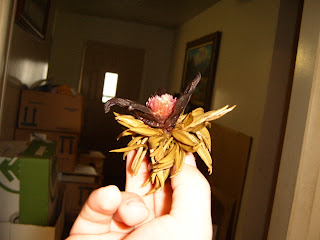
 After I had finished drinking the beverage, I took the bloom out of the mug, and was stumped at what to do next. The idea of throwing such a beautiful flower away was painful, but the idea of not being able to use the mug for the next time I wanted a bloom was even worse. I should have placed it in a clear glass and put it on display (yes, they really are that remarkable), but instead, I tenderly placed it in its final resting place.
 So, to review the entire experience here, I'd have to say that the most common element here is theatre and show. Everything through the whole process is show. The shipping box, the product packaging, the brewing of the beverage, and even the drinking of the beverage are all very visual experiences, and necessarily have a certain theatrical element to them. Everything about this is carefully planned out. IN fact, even the packaging took months to decide on - They wanted packaging that would brighten your day. And they got it.
A couple of weeks ago, I received an email from Mr. Kuperberg which stated that he'd come across this blog, had recently launched a new specialty tea company, and would like to send me some of his products to review complimentary if I'd like.
If any of you know me very well (and I'm not sure that you do), you'd know that I very rarely turn down the opportunity to try something new, very rarely turn down something that doesn't  cost me, and very rarely turn down the good-natured invitations of other people. Since Mr. Kuperberg's email offered all three of these, it was a no-brainer for me, and I told him that I be oh-so-happy to write a review of his products.
I promptly sent him my mailing information and awaited the arrival of what I thought perhaps two or three, but certainly no more than a half dozen samples of his products.
 Several days later, the postlady knocked my door and handed me a rather large package with nice sticker on it that said "FullBloomTea.com" I almost didn't know what to think. I certainly hadn't expected such a large box. Perhaps two or three samples, I had thought. However, when I opened the box, I found a nice card written in fancy emerald green handwriting stating the contents of the box and perhaps some of the cheeriest packaging I'd seen in a long time (see picture.) Also included was his full line of 12 blooming teas, a clear travel mug, and a beautiful glass teapot. I was thrilled. It was like Christmas come a

few days early!
I then set out, over the next few days, to sample some of these teas. In this review, you'll be hearing about the 14 ounce travel mug, although I assure you that a review covering the lovely class teapot will be up within the next couple of weeks. The very first bloom (which is called the friendship bloom) was utterly breathtaking - as if something magical were occurring right there in the mug. I set the water to boil, dropped the bloom in the travel mug, and when the water was boiling, poured it over the bloom. It was absolutely beautiful. Scarlet flower petals uncurled and expanded, and as they did, they slowly released a stream of scarlet color into the water. As the pips on the flower head begun to stand up and get more color, they, too, released streams of scarlet into the water, slowly trickling down. The tea leaves themselves - silver needle white tea leaves - also began to expand outwards, appearing as if they were the base of this lovely flower which was blooming right before my eyes. Floral scent was wafting up from the mug, causing my mood to life. I allowed the tea to bloom for about 5 minutes before I
  drank it.
The tea itself was absolutely delicious. Perhaps some of the best tea I've ever had. This is, no doubt, because it is white tea, which is prized above all teas for it's rareness and delicate flavour.
The tea was almost as good after the second brewing (you can brew each bloom 2-3 times), but I opted not to chance it for a third.
 After I had finished drinking the beverage, I took the bloom out of the mug, and was stumped at what to do next. The idea of throwing such a beautiful flower away was painful, but the idea of not being able to use the mug for the next time I wanted a bloom was even worse. I should have placed it in a clear glass and put it on display (yes, they really are that remarkable), but instead, I tenderly placed it in its final resting place.
 So, to review the entire experience here, I'd have to say that the most common element here is theatre and show. Everything through the whole process is show. The shipping box, the product packaging, the brewing of the beverage, and even the drinking of the beverage are all very visual experiences, and necessarily have a certain theatrical element to them. Everything about this is carefully planned out. IN fact, even the packaging took months to decide on - They wanted packaging that would brighten your day. And they got it.
  This is the most artful tea I've consumed – and I must say it's been the most artfully presented as well.
Now, that being said, I think that most people would not find this an everyday tea. This is the sort of beverage that one might drink when entertaining company, or when celebrating something, or perhaps to give as a gift. Each bloom retails for about $3 a piece, and for the commuter teacup pictured here, the cost is $12. Not a huge cost, but not something most people could afford everyday. It also may be a bit over-elegant for the everyday, unless you're like me, and live on elegance whenever possible.
FullBloomTea.com now has a special offer available, in which you can obtain a free sample for just the cost of shipping ($2.) The sample includes one tea bloom. You can find the link at the top of their home page.
Also, new to their website is a list of all locations that retail their teas. If you are fortunate enough to have one of these in your area, you can skirt the shipping charges on their products by purchasing them at a retail store.
If you're a radio person, you might soon be hearing an advertisement for this company come over the air. These will be valentine-related advertisements. Tea blooms, much like roses, can be used to incite wonderful feelings on a special occasion, and can be used to let someone know that you love them and are thinking about them. Since these blooms have flowers as an integral part of them, what more appropriate gift might one give for valentine's day? "A flower to warm them from the inside out."
Well, that's a wrap for this entry. That's it for the year, and I look forward to having you all read my entries next year as well. I wish you a happy and prosperous 2007, and bid you adieu.
-Relznuk
Monday, December 18, 2006
A Bit of Warmth for the Holidays.
Hello again, readers. It has been almost two months since my last entry to this blog, and I feel a bit bad about that. I felt that I must at least make some sort of post for the holiday season, as this is a special and important time of year for so many people. The traditions of the holiday season carry treasured memories, and many of those memories lie within the tastes and smells that fill kitchens and cups (and the efforts that went into producing those tastes and smells of course!)
Psychologically, smell, more properly referred to as olfaction, is the strongest form of memory. And since taste is so strongly linked to smell, it is not difficult to see why our holiday memories involving food and drink are some of the last to ever be forgotten, if ever they are at all.
I would like to share a couple of ideas for making your teas a little more reminiscent of the holiday season, so that perhaps you might weave some long-lasting memories and traditions of your own.
One of these suggestions involves brewing your tea in fruit juice. I normally would not suggest this, as the very best way to create tea is from pure filtered water, and brewing it in juice could affect the way that flavors and nutrients are extracted from the tea (and result in less tea flavor), but since this has a nice festive sort of flavor, I'll go ahead and throw it out there.
For this recipe, heat some cranberry juice to near-boiling. If you reach boiling, you're a tad too hot, and will need to let your water cool for 30 seconds or so. While the cranberry juice is heating, assemble your tea. This recipe will work best with a black tea, or a green tea if you brew it a little stronger. To your usual tea (of which you ought to have about 1 heaping teaspoon per 6-8 ounces of water, depending on how strong you like it), add some freshly grated orange zest (about half as much orange zest as you have tea, or a bit less. You'll not want to overpower your beverage with orange). This will add a very nice flavor note which I think you will surely appreciate. Also add a bit of whole clove (not ground, or you'll never be able to filter it all out), and some cinnamon bark (but not ground cinnamon... you'll regret it. *shudders at memories of gritty tea*).
Once your cranberry juice is at the proper temperature, pour it over your assembled tea. Brew for 2-3 minutes (no more) in your preferred brewing device (once again, I prefer the french press), and then remove the solid tea from the teapot (or in the case of a french press, press down the plunge lever) and enjoy your finished tea. Most people tend to enjoy this tea with a bit of sugar, even if your generally not the sugar-and-tea sort.
The second holiday tea recipe introduces chestnuts to your tea making arsenal. Chestnuts have a delicious, mildly sweet flavor that makes a wonderful compliment to any tea.
For this tea, you'll need some freshly grated or coarsely ground ginger (anything but powdered), some chestnuts chopped semi-fine (Use either roasted or raw. I prefer roasted.), some cinnamon bark, some cloves, a small amount of orange zest, and of course, the black tea. With this recipe, a 1:1 substitution with green tea would work great as well.
For each cup (6-8 ounces) of tea, assembly 1 heaping teaspoon of tea, a collective teaspoon of equal proportions of ginger and orange zest, one or two cloves (three if you particularly like them), a small piece of cinnamon bark, and about 1/2 teaspoon of chestnuts. If you are making 32 ounces or more, using an entire cinnamon stick broken into smaller peices would be permissable.
Add some water just before the boiling point, and steep for 3-4 minutes. Remove solid tea from teapot (or in the case of a french press, press down the plunge lever), and enjoy the tea.
For those of you interested, here's a link to a poem called "A Cup of Christmas Tea."
I hope that you enjoy these festive tea recipes, and hope that you have a wonderful holiday season, and a happy and prosperous new year. May all of your celebrations be a damn lot of fun.
Cheers (of the holiday sort),
Relznuk
P.S.: I hope you find some consolation in the fact that writing to this blog more often is one of my New Year's Resolutions.
Psychologically, smell, more properly referred to as olfaction, is the strongest form of memory. And since taste is so strongly linked to smell, it is not difficult to see why our holiday memories involving food and drink are some of the last to ever be forgotten, if ever they are at all.
I would like to share a couple of ideas for making your teas a little more reminiscent of the holiday season, so that perhaps you might weave some long-lasting memories and traditions of your own.
One of these suggestions involves brewing your tea in fruit juice. I normally would not suggest this, as the very best way to create tea is from pure filtered water, and brewing it in juice could affect the way that flavors and nutrients are extracted from the tea (and result in less tea flavor), but since this has a nice festive sort of flavor, I'll go ahead and throw it out there.
For this recipe, heat some cranberry juice to near-boiling. If you reach boiling, you're a tad too hot, and will need to let your water cool for 30 seconds or so. While the cranberry juice is heating, assemble your tea. This recipe will work best with a black tea, or a green tea if you brew it a little stronger. To your usual tea (of which you ought to have about 1 heaping teaspoon per 6-8 ounces of water, depending on how strong you like it), add some freshly grated orange zest (about half as much orange zest as you have tea, or a bit less. You'll not want to overpower your beverage with orange). This will add a very nice flavor note which I think you will surely appreciate. Also add a bit of whole clove (not ground, or you'll never be able to filter it all out), and some cinnamon bark (but not ground cinnamon... you'll regret it. *shudders at memories of gritty tea*).
Once your cranberry juice is at the proper temperature, pour it over your assembled tea. Brew for 2-3 minutes (no more) in your preferred brewing device (once again, I prefer the french press), and then remove the solid tea from the teapot (or in the case of a french press, press down the plunge lever) and enjoy your finished tea. Most people tend to enjoy this tea with a bit of sugar, even if your generally not the sugar-and-tea sort.
The second holiday tea recipe introduces chestnuts to your tea making arsenal. Chestnuts have a delicious, mildly sweet flavor that makes a wonderful compliment to any tea.
For this tea, you'll need some freshly grated or coarsely ground ginger (anything but powdered), some chestnuts chopped semi-fine (Use either roasted or raw. I prefer roasted.), some cinnamon bark, some cloves, a small amount of orange zest, and of course, the black tea. With this recipe, a 1:1 substitution with green tea would work great as well.
For each cup (6-8 ounces) of tea, assembly 1 heaping teaspoon of tea, a collective teaspoon of equal proportions of ginger and orange zest, one or two cloves (three if you particularly like them), a small piece of cinnamon bark, and about 1/2 teaspoon of chestnuts. If you are making 32 ounces or more, using an entire cinnamon stick broken into smaller peices would be permissable.
Add some water just before the boiling point, and steep for 3-4 minutes. Remove solid tea from teapot (or in the case of a french press, press down the plunge lever), and enjoy the tea.
For those of you interested, here's a link to a poem called "A Cup of Christmas Tea."
I hope that you enjoy these festive tea recipes, and hope that you have a wonderful holiday season, and a happy and prosperous new year. May all of your celebrations be a damn lot of fun.
Cheers (of the holiday sort),
Relznuk
P.S.: I hope you find some consolation in the fact that writing to this blog more often is one of my New Year's Resolutions.
Saturday, October 21, 2006
I Heart Green Tea - And it Hearts Me!
Yeah. I know what you're thinking. I'm thinking it too... The title sucks. But the title is easily the least important part of any article I write (at least that it what I say to make myself feel better. lol.)
Before I get started on the bulk of the post, I would like to make a couple of announcements. The first, and most exciting of these announcements, is that this blog now displays perfectly in Internet Explorer, whereas before it would only work in FireFox. That 's a fine bit of news, I'd dare say. The second announcement is that I have entered an interesting tea recipe contest. More on that after I recieve the results (depending on how well the recipe does, I may just have to post that here as well!) Now, on to the real article. The one you've been waiting for. The one you've been dying (not really) to read.
Today's posting will be about some interesting benefits of green tea.
According to a recent Japanese study, folks who drink at least a pint of green tea a day have a much lower risk of death. This is good news! This is due to the decrease in the risk of heart disease that can be obtained from drinking green tea. This effect is more potent in women than men, but men can experience the positive benefits of tea also!
The reason that women seem to get more benefit from green tea then men has puzzled many people over the years, although it appears to be related to estrogen (as well as smoking, which mend tend to do more of than women.)
With the benefits of green tea, a couple of caveats were mentioned. One of these being that people one blood thinners should not take it, as green tea contains Vitamin K (the body's cheif blood clotting agent), and it should not be drunk at too high of temperatures.
For more information on the relationship between green tea and heart health, visit:
http://www.medicinenet.com/script/main/art.asp?articlekey=64083
Thanks for reading!
Cheers,
Relznuk
Before I get started on the bulk of the post, I would like to make a couple of announcements. The first, and most exciting of these announcements, is that this blog now displays perfectly in Internet Explorer, whereas before it would only work in FireFox. That 's a fine bit of news, I'd dare say. The second announcement is that I have entered an interesting tea recipe contest. More on that after I recieve the results (depending on how well the recipe does, I may just have to post that here as well!) Now, on to the real article. The one you've been waiting for. The one you've been dying (not really) to read.
Today's posting will be about some interesting benefits of green tea.
According to a recent Japanese study, folks who drink at least a pint of green tea a day have a much lower risk of death. This is good news! This is due to the decrease in the risk of heart disease that can be obtained from drinking green tea. This effect is more potent in women than men, but men can experience the positive benefits of tea also!
The reason that women seem to get more benefit from green tea then men has puzzled many people over the years, although it appears to be related to estrogen (as well as smoking, which mend tend to do more of than women.)
With the benefits of green tea, a couple of caveats were mentioned. One of these being that people one blood thinners should not take it, as green tea contains Vitamin K (the body's cheif blood clotting agent), and it should not be drunk at too high of temperatures.
For more information on the relationship between green tea and heart health, visit:
http://www.medicinenet.com/script/main/art.asp?articlekey=64083
Thanks for reading!
Cheers,
Relznuk
Saturday, September 30, 2006
Oh... How sweet! Or is it?
As you might have guessed, today's post is about giving tea as a romantic gift. Or not. Actually, it's about sweeteners, and what sweeteners one ought to use in their tea. We will talk about several different artificial sweeteners, and several different natural ones.
The idea of sweetening tea can a sensitive topic. Many tea-related topics can be sensitive topics. People are sensitive about their tea. Some people firmly believe that tea ought not to be sweetened (I prefer not to sweeten my teas), so as to enjoy the natural flavor of the brew. Others believe that tea should only be sweetened with honey. Others that one should take the low-calorie approach and go with something like aspartame, sorbitol, or sucralose (splenda). But whatever you think, you probably have a good reason for it. For the sake of this article, we are going to assume that you are one of those that likes to sweeten your tea.
I am going to go over some of the reasons that people use various sweeteners.
Honey
Many people like to use honey to sweeten their teas, whatever kind of tea it is. Honey can be processed differently in the system that other sugars, because it is already partially digested. Another reason that many like to use honey to sweeten their teas is because honey has it's own interesting flavor, which many feel complements the flavor of their beverage. Also, honey may be slightly less caloric than other sugars.
Granular Sugar (beet or cane, including sugar cubes)
There are a number of reasons why people choose to use granular sugar in their beverages. The most popular of these reasons is because it's what is available. Most people have a bunch of this sitting around their homes. Also, many believe it to be the safest sweetener, although this may or may not be true. There are several different forms of granular sugar, including raw sugar (unprocessed dehydrated cane extract), turbinado, or the bagged white sugar that is all so common. Another popular reason that many people use granular sugar is that is *doesn't* add a flavor of it's own to the beverage.
Agave Nectar, Brown Rice Syrup, etc.
Many people interested in natural foods tend to go for sweeteners such as Agave Nectar or Brown Rice Syrup because they believe them to be cleaner, safer, better forms of sugar. Some of these can be sweeter than table sugar, and some have their own flavor profiles which can be enjoyed in beverages.
Aspartame
Aspartame is the sweetener of choice for many diabetics, although it has decreased in popularity in recent years. The most popular reasons to use it is that it is non-caloric and doesn't absorb into your blood stream as a sugar (although many recent studies are finding that your body does, in fact, process it into sugar). One caveat about aspartame, however, is that it is processed by your liver into a form of formaldehyde (embalming fluid), which then becomes toxic.
Sorbitol and Xylitol
Largely, these are used for the same reasons that Aspartame would be used. They are low-calorie, and diabetic friendly. They also do not promote tooth decay. Another interesting reason that some choose to use these over artificial sweeteners is that they are sugar alcohols, and hence, a natural occuring thing. One caveat here is that sorbitol and like substances have laxative properties which can make your tea experience quite an adventure.
Splenda
Splenda (sucralose) is a fairly new sweetener on the scene. It is actually a restructured sugar molecule that the body cannot process. While many tout it for it's sweeter-than-sugar taste and it's high usability, this product is starting to gain the caution of the wary consumer. It, like sacharin and aspartame and other artificial sweeters, has been found to cause health problems. Also, since molecular restructuring is not at all a natural process, many choose to stay away from this. Not to mention the aftertaste...
AND LAST, BUT CERTAINLY NOT LEAST,
Stevia
Stevia, also called sweatleaf is a naturally occuring plant sugar of plant origin. It is many times sweeter than standard sugar, is extremely low calorie, and is safe for the use of diabetics. Many choose to use this because of it's natural origin. Others choose to use it because of it's low caloric value and high sweetness. Also, most people report that stevia has little or no aftertaste and is a suitable alternative to sugar. It also contains micronutrients and some interesting health properties. I would consider this the best alternative to caloric sugars. Leaves of stevia can actually be brewed *with* the tea to sweeten it, making it un-necessary to add anything.
Traditionally, it is most common to use table sugar in your tea (in the form of a sugar cube, or "lump,") but many people cannot or will not do that.
I leave it to you to draw your own conclusions about which sweetener you choose. If you cannot or choose not to be a traditionalist, then my reccomendation would be to choose a nectar or syrup, or my personal favorite alternative sweeter, stevia.
Thanks once again for reading, and have a great day!
Cup o' Tea,
Relz
The idea of sweetening tea can a sensitive topic. Many tea-related topics can be sensitive topics. People are sensitive about their tea. Some people firmly believe that tea ought not to be sweetened (I prefer not to sweeten my teas), so as to enjoy the natural flavor of the brew. Others believe that tea should only be sweetened with honey. Others that one should take the low-calorie approach and go with something like aspartame, sorbitol, or sucralose (splenda). But whatever you think, you probably have a good reason for it. For the sake of this article, we are going to assume that you are one of those that likes to sweeten your tea.
I am going to go over some of the reasons that people use various sweeteners.
Honey
Many people like to use honey to sweeten their teas, whatever kind of tea it is. Honey can be processed differently in the system that other sugars, because it is already partially digested. Another reason that many like to use honey to sweeten their teas is because honey has it's own interesting flavor, which many feel complements the flavor of their beverage. Also, honey may be slightly less caloric than other sugars.
Granular Sugar (beet or cane, including sugar cubes)
There are a number of reasons why people choose to use granular sugar in their beverages. The most popular of these reasons is because it's what is available. Most people have a bunch of this sitting around their homes. Also, many believe it to be the safest sweetener, although this may or may not be true. There are several different forms of granular sugar, including raw sugar (unprocessed dehydrated cane extract), turbinado, or the bagged white sugar that is all so common. Another popular reason that many people use granular sugar is that is *doesn't* add a flavor of it's own to the beverage.
Agave Nectar, Brown Rice Syrup, etc.
Many people interested in natural foods tend to go for sweeteners such as Agave Nectar or Brown Rice Syrup because they believe them to be cleaner, safer, better forms of sugar. Some of these can be sweeter than table sugar, and some have their own flavor profiles which can be enjoyed in beverages.
Aspartame
Aspartame is the sweetener of choice for many diabetics, although it has decreased in popularity in recent years. The most popular reasons to use it is that it is non-caloric and doesn't absorb into your blood stream as a sugar (although many recent studies are finding that your body does, in fact, process it into sugar). One caveat about aspartame, however, is that it is processed by your liver into a form of formaldehyde (embalming fluid), which then becomes toxic.
Sorbitol and Xylitol
Largely, these are used for the same reasons that Aspartame would be used. They are low-calorie, and diabetic friendly. They also do not promote tooth decay. Another interesting reason that some choose to use these over artificial sweeteners is that they are sugar alcohols, and hence, a natural occuring thing. One caveat here is that sorbitol and like substances have laxative properties which can make your tea experience quite an adventure.
Splenda
Splenda (sucralose) is a fairly new sweetener on the scene. It is actually a restructured sugar molecule that the body cannot process. While many tout it for it's sweeter-than-sugar taste and it's high usability, this product is starting to gain the caution of the wary consumer. It, like sacharin and aspartame and other artificial sweeters, has been found to cause health problems. Also, since molecular restructuring is not at all a natural process, many choose to stay away from this. Not to mention the aftertaste...
AND LAST, BUT CERTAINLY NOT LEAST,
Stevia
Stevia, also called sweatleaf is a naturally occuring plant sugar of plant origin. It is many times sweeter than standard sugar, is extremely low calorie, and is safe for the use of diabetics. Many choose to use this because of it's natural origin. Others choose to use it because of it's low caloric value and high sweetness. Also, most people report that stevia has little or no aftertaste and is a suitable alternative to sugar. It also contains micronutrients and some interesting health properties. I would consider this the best alternative to caloric sugars. Leaves of stevia can actually be brewed *with* the tea to sweeten it, making it un-necessary to add anything.
Traditionally, it is most common to use table sugar in your tea (in the form of a sugar cube, or "lump,") but many people cannot or will not do that.
I leave it to you to draw your own conclusions about which sweetener you choose. If you cannot or choose not to be a traditionalist, then my reccomendation would be to choose a nectar or syrup, or my personal favorite alternative sweeter, stevia.
Thanks once again for reading, and have a great day!
Cup o' Tea,
Relz
Tuesday, September 26, 2006
Tea and Mood... What shall I drink today?
Today's post is going to be of more a contemplative nature than an informative one. I hope you enjoy it and find it interesting and thought-provoking.
Every tea lover knows that there are a great number of teas available for consumption. Many tea drinkers, however, select one or two different types of tea, and then just roll with that day after day, never changing their routine, and remaining constant with the type tea that they select.
I, on the other hand, find that there is something to be said for using tea as a mood device. Certain teas taste differently according to moods. This works psychologically due to the fact that everybody has their "comfort flavors" that they have become accustomed to. Additionally, most people have flavors that they associate, for one reason or another, with pain, sadness, misery, celebration, or any assortment of feelings. Because of this, depending on the mood they are in, their mind is going to pick out a different aspect of that tea's flavor profile.
Many people will choose a tea contrary to their current mood in the hopes that it might remind them of some other experience and change their mood, or that some flavor or substance in the tea, or the fact that they have a hot cup in from of them in the first place will do something about changing the mood that they are in.
It is philosophically interesting to note that different people drink different teas for different reasons, and that the flavor of a certain tea for one person might be experienced entirely differently in another person. This is because taste and the perception of flavor are relative. There is also something to be said for the idea that fragrances can trigger certain modes of thinking, and the same thing that has just been noted for flavor can be doubly noted for fragrance. The olfactory sense, or sense of smell, is linked to our strongest form of memory. Our sense of smell triggers memories better than any of our other senses. Hence, one might select a tea of a certain fragrance depending on what mood their in.
But whatever mood your in, and whatever your reasons for selecting a tea, it is almost universally agreed upon that tea is a comfort food, most often used for relaxation and to bring consolation.
Draw from this whatever conclusions you may like. I personally find that I often have more of an emotional connection to the tea I am drinking that I am willing to admit. If you, also, feel emotionally connected somehow to the teas that you drink, please let us know! I welcome your comments to this post!
Thanks for reading.
Signing off,
Relznuk
Every tea lover knows that there are a great number of teas available for consumption. Many tea drinkers, however, select one or two different types of tea, and then just roll with that day after day, never changing their routine, and remaining constant with the type tea that they select.
I, on the other hand, find that there is something to be said for using tea as a mood device. Certain teas taste differently according to moods. This works psychologically due to the fact that everybody has their "comfort flavors" that they have become accustomed to. Additionally, most people have flavors that they associate, for one reason or another, with pain, sadness, misery, celebration, or any assortment of feelings. Because of this, depending on the mood they are in, their mind is going to pick out a different aspect of that tea's flavor profile.
Many people will choose a tea contrary to their current mood in the hopes that it might remind them of some other experience and change their mood, or that some flavor or substance in the tea, or the fact that they have a hot cup in from of them in the first place will do something about changing the mood that they are in.
It is philosophically interesting to note that different people drink different teas for different reasons, and that the flavor of a certain tea for one person might be experienced entirely differently in another person. This is because taste and the perception of flavor are relative. There is also something to be said for the idea that fragrances can trigger certain modes of thinking, and the same thing that has just been noted for flavor can be doubly noted for fragrance. The olfactory sense, or sense of smell, is linked to our strongest form of memory. Our sense of smell triggers memories better than any of our other senses. Hence, one might select a tea of a certain fragrance depending on what mood their in.
But whatever mood your in, and whatever your reasons for selecting a tea, it is almost universally agreed upon that tea is a comfort food, most often used for relaxation and to bring consolation.
Draw from this whatever conclusions you may like. I personally find that I often have more of an emotional connection to the tea I am drinking that I am willing to admit. If you, also, feel emotionally connected somehow to the teas that you drink, please let us know! I welcome your comments to this post!
Thanks for reading.
Signing off,
Relznuk
Friday, September 22, 2006
The Rage about Rooibos...
Today I want to introduce you to a new tea. This is likely a far different tea than you have tasted or heard of before, but it is a most fantastic tea nonetheless, and when I want a tea without the caffeine (which sometimes happens, as I don't get any effect from caffeine anyway), this is my tea of choice. It is called Rooibos tea, otherwise known as African Red Tea.
Here's a bit of the history on Rooibos.
Over three hundred years ago, native inhabitants of the mountainous regions of South Africa's Western Cape were the first to collect wild rooibos and make it into tea. They had discovered that they could brew a sweet, tasty tea from rooibos leaves and stems that they cut, bruised with wooden hammers, fermented in heaps, and then sun-dried (seems like quite a process, eh?). Botanists first recorded rooibos plants in 1772 when they were introduced to the tea by the Khoi people.
Since that time, Rooibos has grown in popularity. A great bit of this popularity (at least in America) came during WWI,I when tea supplies from Asia forced drinkers to find an alternative. Rooibos tea was more than up to the task. Today, with the many amazing health benefits surfacing and many flavors available, rooibos tea has far surpassed its role as an alternative beverage.
Either fermented or nonfermented versions of rooibos tea are available, although the unfermented are more difficult to find and are generally more expensive.
Rooibos, as with most teas, works best when brewed loose leaf. Rooibos is naturally low in tannins, has a somewhat earthy taste with no bitterness, and has some amount of appeal to children (most children will drink it without sugar.) It is extrememly high in antioxidants and micronutrients, extremely low in tannins (and hence has no bitterness), and fairly high in flavor. It is available at most whole herb vendors.
So, if you are looking for something new to try, or looking for a way to enjoy the sameness of tea without the caffeine or tannins, I highly recommend that you give Rooibos a try! You'll be glad you did!
Over and out,
Relz
Here's a bit of the history on Rooibos.
Over three hundred years ago, native inhabitants of the mountainous regions of South Africa's Western Cape were the first to collect wild rooibos and make it into tea. They had discovered that they could brew a sweet, tasty tea from rooibos leaves and stems that they cut, bruised with wooden hammers, fermented in heaps, and then sun-dried (seems like quite a process, eh?). Botanists first recorded rooibos plants in 1772 when they were introduced to the tea by the Khoi people.
Since that time, Rooibos has grown in popularity. A great bit of this popularity (at least in America) came during WWI,I when tea supplies from Asia forced drinkers to find an alternative. Rooibos tea was more than up to the task. Today, with the many amazing health benefits surfacing and many flavors available, rooibos tea has far surpassed its role as an alternative beverage.
Either fermented or nonfermented versions of rooibos tea are available, although the unfermented are more difficult to find and are generally more expensive.
Rooibos, as with most teas, works best when brewed loose leaf. Rooibos is naturally low in tannins, has a somewhat earthy taste with no bitterness, and has some amount of appeal to children (most children will drink it without sugar.) It is extrememly high in antioxidants and micronutrients, extremely low in tannins (and hence has no bitterness), and fairly high in flavor. It is available at most whole herb vendors.
So, if you are looking for something new to try, or looking for a way to enjoy the sameness of tea without the caffeine or tannins, I highly recommend that you give Rooibos a try! You'll be glad you did!
Over and out,
Relz
Subscribe to:
Posts (Atom)